
TIME
Use existing pockets of time that you get together with the team/team members to have these conversations. Ideally you have a Conversations Roadmap for your team for 12months. This Roadmap could include team meetings, team briefings, team days, regular 1-2-1s, performance reviews and development conversations. It becomes an inherent part of operational reality and not something that is deprioritised in times of high stakes delivery.
Listen to Fiona talking about the importance of creating Thinking Environments and the role of the Facilitator as a Thinking Partner.
Detailed outlines are available for all these conversation starters.
All of the tools described and the supporting documents are available as downloads under the description.
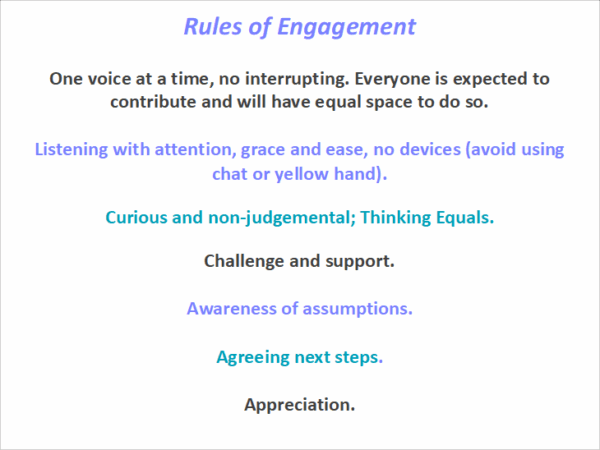
RULES OF ENGAGEMENT
After you have the time agreed and you are clear on what the conversation is focusing on and what tools/frameworks you are using, the next step is setting the Rules of Engagement. These work in all situations, online, in person, 1-1 and with groups. You have all experienced this way of working on the programme with myself and the team. We have discovered that these Rules of Engagement are game changing in terms of engagement and progression.
In a group situation you give everyone a turn to speak, we often say, ‘Who would like to go first?’ and then “Who would like to go next?’ or you simply say where you will start and finish.
If it’s 1-1 it is still important to do this and explain that you will be in a listening role. Here’s a form of words as a starter.
- Before we begin it can be helpful to confirm that my role is to help you to do your best thinking, I will not interrupt you or verbally respond to your thinking.
- It would be helpful for me if we can agree how you will let me know that one wave of thinking is complete, for example, ‘That’s everything for now.’.
- Only when I am sure that you are ready will I ask you another question. That may be the same question I have already asked, or it may not.
- Either way my only desire is to help you to discover your best thinking.
ROLE OF THE LEADER/FACILITATOR IN THESE CONVERSATIONS
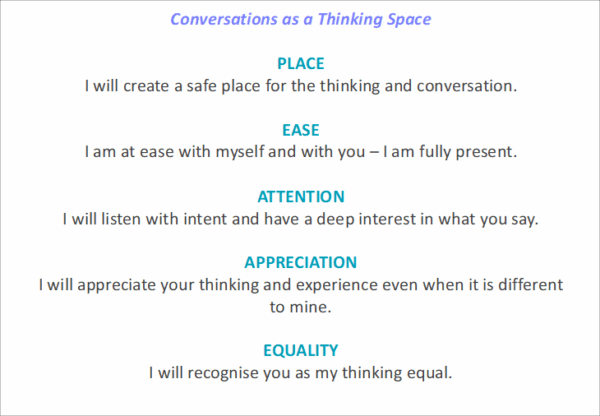
Nancy Kline who developed the concept of Thinking Environments, describes the role of the person supporting the thinking, as being both essential and irrelevant. In a world where leaders are expected to come up with the answers, this is a different kind of conversation where you use inquiry and deep listening to create space for others to think.
Your fundamental role is to help others to think better for themselves. These conversations do not have a right and a wrong answer, only an energy towards self-awareness, change and positive outcomes, owned by the individual or the team.
You do this by:
- Listening deeply and inquiring with genuine curiosity.
- Surfacing connectedness based on listening, genuineness and not knowing.
- Assuming that positive team and personal relationships are critical to business success.
- Giving structure to the emotional dimension of the work and the workplace.
- Supporting the Thinker to make decisions around assumptions.
- Supporting the Thinker to surface doubts and commitments, moving the thinking, decisions, and action forward.
- Encouraging directness, authenticity, and personal accountability.
- Giving permission for silence and then not filling it!
- Avoiding advice; it’s not about you. Your job is to help the other person/people think better for themselves.
POWERFUL QUESTIONS FOR CONVERSATIONS

To get deep thinking below the horizon we need to ask the questions that are powerful. Thinking about which questions we want to ask in advance and planning the space for responses is at the heart of this way of inquiring.
The scope of the question is the membrane or the boundary within which the responses can be made. If the question is about eliciting stories of strengths at work in a particular team, then that needs to be explicit in the question. All roads lead back to the question because you get what you ask about.
ASSUMPTIONS
All questions hold assumptions and the language that we use has a huge impact. The difference with Powerful Questions is that they are designed explicitly with a positive assumption. They assume there is a positive story to be shared, an idea to be explored or a decision that can be agreed. So “Why does it matter to you?” assumes that it does matter, “What if you could turn this situation around?” assumes that you can and “What would you do now if you had no fear?” assumes that you have ideas that could be valuable.
USING POWERFUL QUESTIONS
Powerful Questions are helpful in almost any situation. We encourage you to try them anywhere and everywhere. If you are faced with silence and a puzzled expression, then you are on the way. You will need to manage silence, wait with interest, and listen with appreciation and ease. On no account interrupt or disagree. Just listen and learn and then ask, “What more do you think or feel or want to say?”
CONSTRUCTING POWERFUL QUESTIONS
The checklist that follows is a useful way of checking whether the question you have is powerful enough. It takes time and practice because we are not used to preparing questions in this way. It is worth it and the knowledge you will gain as a leader is invaluable.
- What question, if explored thoroughly, could provide the breakthrough possibilities we are seeking?
- Is the question relevant to the real life or real work of the people who will be exploring it?
- Is this a genuine question; a question to which I/we really don’t know the answer?
- What work do I want this question to do? That is, what kind of conversation, meanings and feelings do I imagine this question will evoke in those who will be exploring it?
- What assumptions or beliefs are embedded in the way this question is constructed?
- Is this question likely to generate hope, imagination, engagement, new thinking, and creative action, or is it likely to increase a focus on past problems and obstacles?
- Does this question leave room for new and different questions to be raised as the initial question is explored?
All of the tools that follow use Powerful Questions in one form or another. They all come from a belief that people can think for themselves and that the role of the Facilitator/Leader/Thinking Partner is to listen well, be fully present and be genuinely interested.