
VALUES: An introduction to surfacing Personal Values and connecting them to behaviours. See this section.
COMMUNICATION PREFERENCES & TRANSACTIONAL ANALYSIS: An introduction to Transactional Analysis, supporting the understanding of personal communication preferences and the impact on others. See this section.
APPRECIATIVE INQUIRY CONVERSATIONS: An introduction to the philosophy of asking questions about what is working and what is possible. Coming at challenges from the other side of the revolving door. See this section.
WHAT’S WORKING GRIDS (WWG): An introduction to the framework and how to use it, including examples. See this section.
POWERFUL QUESTIONS CARDS: Fun ways of asking big questions, an easy way to put Appreciative Inquiry into practice. See this section.
VALUES CONVERSATION
The concept of personal values is both complex and simple. Complex because these values are likely to have started in our family of origin and have been developed by our life experiences and core beliefs. Simple because it is easy to see how values drive our behaviour.
The beliefs of parents and parental figures shape the early development of our values. These beliefs can be social, political, religious and moral and will be impacted by place, education and social standing. The subsequent values are likely to be how we approached the world and made judgements about good/bad, right and wrong, appropriate and not appropriate. These beliefs and values form our attitude and how we think about people, places and situations.
As we grow and develop, and are exposed to wider influences and experiences, our beliefs, values and attitudes change. As adults we have beliefs, values and attitudes that are developed independently of those of parents and parental figures, as well as those that we choose to keep from those early influences.
People care about values. Some care a lot and will actually decide who they work for and why based on the value proposition and how an organisation measures up to its professed values.
A 2018 survey by LinkedIn found that values are the number one priority for employees. Just under two thirds (71%) would take a pay cut to work for a company that has shared values and a mission they believe in and 39% would leave their current job if their employer asked them to do something that conflicted with their own morals or ethics. Almost half (47%) want to work in an environment where they can be themselves and have a positive effect on society (46%).
TIME
Make sure you plan the conversations in advance, explain why they are happening and affirm that there are no right and wrong response. 15 minutes to complete the survey. 30 minutes for a 1-1 conversation and 60 minutes for a small group conversation. You can use some of the Powerful question cards here too, just sift out the ones that you think would work.
THE PROCESS
- The opportunity for each person is in the first instance to crystallise their own personal values. The link below will take you to an online Values Audit. https://personalvalu.es/
- There after you could use a What’s Working Grid or just asked them to reflect on how they see their values showing up at work, how do they help, how do they get in the way.
- This could then be linked to a PDP or a conversation around Communication Preferences or their Strengths.
Listen to Fiona talking about values
COMMUNICATION PREFERENCES
Listen to Fiona talking about Transactional Analysis
We all have communication preferences; these have been developed over time since we were small and have been impacted by parents and parental figures, our feelings and emotions and what we have learned as we have grown and developed.
Eric Berne created a framework that helps explain these patterns, when and where they are helpful and when and where they can get in the way for us.
Understanding our preferences and those of others can help us to respond rather than to react and to be considered about what and how we say things, especially in high stakes situations.
TIME
Make sure you plan the conversations in advance and explain why they are happening and that there are no right and wrong responses. 15 minutes to complete the self-assessment. 30 minutes for a 1-1 conversation and 60 minutes for a small group conversation.
THE PROCESS
- The opportunity for each person is in the first instance to crystallise their own communication preferences, using the tool TA 2025 in the Tools tab.
- There after you could use the Communication What’s Working Grid or just asked them to reflect on how they see their preferences show up at work, how do they help, how do they get in the way.
- If it is a group, then I suggest you use the Communication What’s Working Grid to enable conversations to take place from a similar start point.
- This could then be linked to a PDP.
APPRECIATIVE INQUIRY CONVERSATION
Appreciative Inquiry is a positive change framework. This works for 1-1 conversations and in groups of all sizes. If you want to plan a bigger Appreciative Inquiry, please reach out and we are happy to help you with that.
To enable easy application of Appreciative Inquiry, we use the 4D model. This guidance is for a 1-1 conversation.
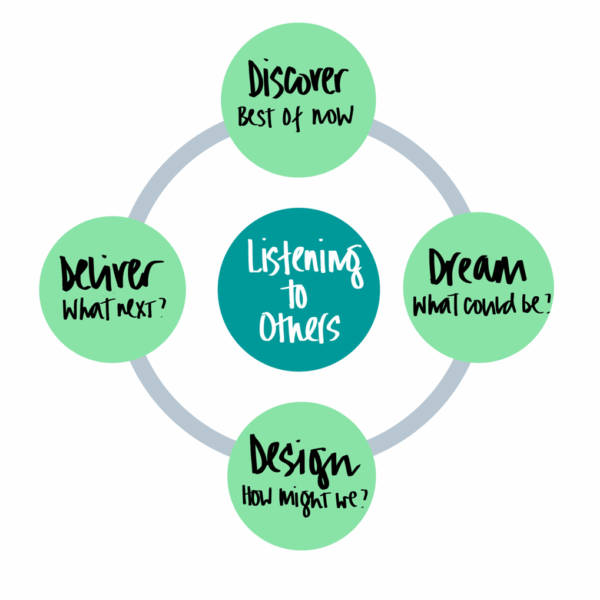
TIME: 50 minutes – including setting up and getting feedback.
Ensure that the conversations are planned in advance.
GETTING TO THE QUESTIONS
When you are preparing to facilitate an Appreciative Inquiry or AI the critical starting point is around the area that you want to be better. Once you have agreed on that use the Powerful Questions Cards and the Handout on Powerful Questions to help you to form your Discovery questions, these are at the hear of your AI as they will encourage stories about what is working in the area you want to improve, what happens on the best day, where have they had experience of the topic working elsewhere, what were the conditions that enabled that etc. We are very happy to provide you with feedback on your questions before you get going.
THE PROCESS
- Everything in the earlier sections around creating Thinking Space (page 5) applies here.
- 5 minutes to set the scene, thanking them for taking the time and committing to follow up in 8 weeks to see how they have got on.
- I think 10 minutes for each of the 4Ds.
- 5 minutes to ask for feedback and offer appreciation.
- The questions offered are a guide only, there are lots of questions in the Powerful Questions section of this guide and also on the cards that work too.
- Whilst some of these questions are about strengths, they can speak about this in the abstract and not directly connected to their Gallup profile.
- No need to make notes in fact I would advise against it, just be fully present and curious.
QUESTIONS – DISCOVERY – The best of now and the recent past; unlocking stories.
These questions are story orientated. The responses don’t need to be work based.
Tell me about a time in the last 4 weeks when you were able to make a real difference?
And what more, would you say about what it felt like to make a difference?
QUESTIONS – DREAMING – What could be: visions of possibility.
These questions are future orientated.
Connecting to what you said about making a difference, what would it be like if you could do that more in other parts of your role/life?
How would that impact your motivation?
What if that kind of feeling was prevalent across the team?
QUESTIONS – DESIGN – Ideas for change.
These questions are idea orientated and take the thinking forward.
What ideas do you have about what we’ve talked about?
What do you need from me?
QUESTIONS – DESTINY/DELIVER – Actions.
These questions are action orientated and take the thinking forward.
What’s the first step and how will you know if it’s working?
What do you need from me?
INTRODUCING THE WHAT’S WORKING GRID (WWG)
The WWG is a practical tool based on the Appreciative Inquiry theory about building on what’s working to navigate next steps. A variety of WWGs are available as pptx slides, and we have provided an ‘empty’ grid for you to use for topics that matter to you and your team/stakeholders etc.
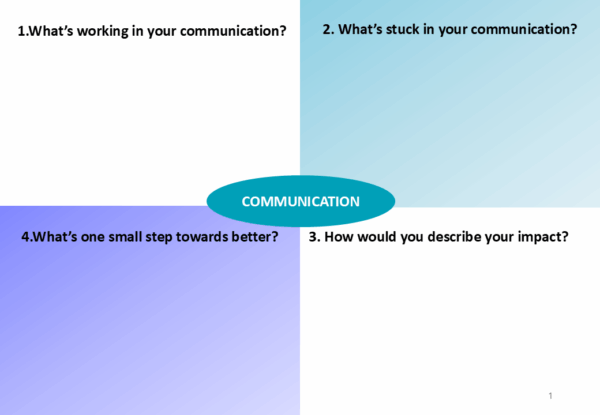
TIME
Ensure that the conversations are planned in advance. I would be tempted to start with people where you have a good relationship and remember to explain why you are having conversations in a different kind of way.
THE PROCESS
- This works well on a 1-1 basis and in groups, the latter coupled with the 1,2,4 framework.
- Use one of the provided WWG or decide what you want to explore and put that topic/project/behaviour in the centre of the WWG.
- Give the person or people the WWG at least 1 week in advance of the conversation.
- If it’s a 1-1, 30-60 minutes depending on the topic. Where you are also completing the WWG as well as the person it prior to the conversation (Strengths/Performance/Feedback) will need a bit longer.
- If it’s a group (3-12) then a minimum of 60 minutes.
- If it is a generic WWG about a project, change or collective strengths, then you can put people into pairs to complete a composite grid and then put 2 pairs together to produce a final composite.
- This really crystallises thinking and you can take the final grids away and summarise those and next steps.
- Around 20 minutes to complete for self (or in advance), 15 minutes in a pair and 20 minutes in the four.
- The key as with all these conversation starters they need to be real things that are being spoken about, and you need to follow up with next steps within 5 working days.
Downloads
INTRODUCING THE POWERFUL QUESTIONS CARDS
On the Personal Leadership Programme, delegates were introduced to the idea of Powerful Questions. Each leader was given a pack of Powerful Question cards. These cards way of them uncovering thinking and feeling that may not have been obvious to you or to the people taking part previously.
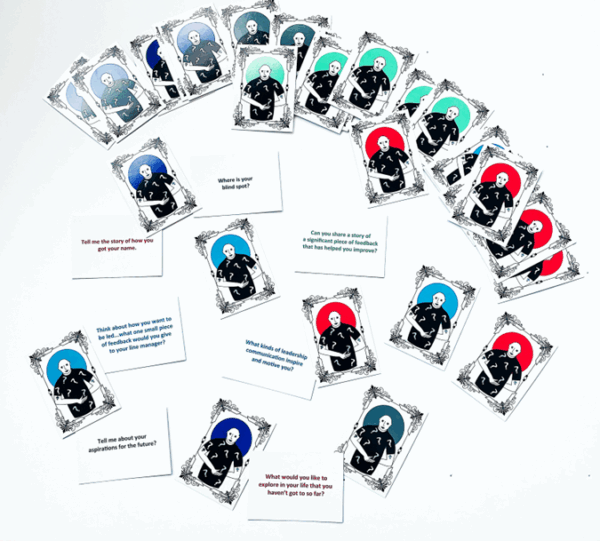
TIME: 30 minutes (1-1 or 60 minutes in a small group)– including setting up and getting feedback.
Ensure that the conversations are planned in advance, you could ask for volunteers from the team, however if you do it this way it is important to try it with a mix of people and not just the usual suspects that volunteer for everything. I also think it’s a great process with a small team so no more than 10, or in small groups of 4 which might feel safer. Ideally you have a call explaining it. On no account should this just be an email.
I think you try it first face to face with people. It does work online, and Sharni Purvis has created a fantastic Excel Spreadsheet that will allow random choosing.
PROCESS FOR BOTH 1-1 AND GROUP
- Everything in the earlier sections around creating Thinking Space (page 5) applies here.
- 5 minutes to set the scene, thanking them for taking the time.
- Ideally you try both ways; 1-1 and a small group with different people.
1-1 CONVERSATIONS
- Cards are spread out on the table face up, questions not showing.
- Ask the person to pick any card and ask you the question. Answer as fully and openly as you can.
- Next reverse the process. You can always ask them the additional ‘what more would you like to think or feel or want to say’.
- Swap again this time ask them to ask you what more question after your initial responses.
- Swap again, this time give the person the opportunity to choose a card by looking at the questions. Respond to the question as fully and openly as possible.
- Repeat with you asking them a card you have chosen.
- Ask the person how they felt about the process and where it could be used in the wider team.
- Finally offer them some appreciation for getting involved and let them know you will feedback the results.
SMALL GROUP
- Cards are spread out on the table face up, questions not showing.
- Ask the first person to pick any card, read out the question and respond to the question as fully and openly as they can.
- If the question is too personal, they can put it back and choose another (not over and over).
- After each person you can come in with the ‘what more’ question. The easiest way to do this is to add it to the question for example…so Fiona what more would you like to say about.
- Next person does the same and so on until everyone including you has responded to one question.
- Depending on time and numbers, you could divide them into two smaller groups and they have another round.
- Ask the group how they felt about the process and where it could be used in the wider team.
- Finally offer them some appreciation for getting involved and let them know you will feedback the results.