Listen to Andy talking about strengths in a personal and organisational context
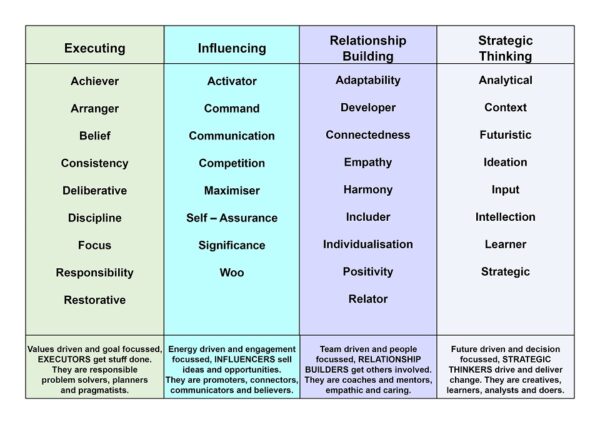
Gallup Strengths, also known as Clifton Strengths Finder, are 34 talent themes identified by an online assessment that uncover an individual’s natural patterns of thought, feeling, and behaviour. These are categorised into four domains: Executing, Influencing, Relationship Building, and Strategic Thinking. The assessment helps people understand their innate abilities to develop their greatest talents into strengths for professional and personal growth.
What the assessment does:
Identifies natural talents
The assessment identifies your top talent themes based on your answers to paired statements about yourself. Talent is defined as a naturally recurring pattern of thought, feeling, or behaviour that can be productively applied.
Focuses on strengths
Unlike traditional assessments that focus on weaknesses, Gallup Strengths emphasizes your natural abilities, with the goal of using them to achieve greater success.
Offers actionable insights
The results help you understand what you naturally do best and how to develop your greatest talents into strengths, providing a roadmap for accomplishments in your career and personal life.
For you to work effectively through this section of tools the people you are working with will need to have completed the above assessment. We recommend the book “How Full is Your Bucket” by Tom Rath which has the assessment at the back. You will need a new hardbacked anniversary addition, as not all editions have the assessment. This is available on Amazon/Wordery etc.
INTRODUCING STRENGTHS
This is directly related to the person/people taking part in these conversations, having read ‘How Full is Your Bucket’ and completed the strengths assessment. Not all editions of the book have the assessment. You need a new hardbacked Expanded Anniversary Edition.
Once the book has been read and the assessment completed you could facilitate this as a team introduction or a series of 1-1s.
TIME: 60 minutes (1-1) or 90 minutes (small group) – including setting up and getting feedback.
Ensure that the conversations are planned in advance, you could ask for volunteers from the team, however you do it this is important to try it with a mix of people and not just the usual suspects that volunteer for everything. I also think it’s a great process with a small team so no more than 10, or in small groups of 4- might feel safer. Ideally you have a call explaining it. On no account should this just be an email.
I think for the purposes of the Change Experiment you try to be face to face with people. It does work online but it’s not as effective.
PROCESS FOR BOTH 1-1 AND GROUP
- Everything in the earlier sections around creating Thinking Space (Page 5) applies here.
- 5 minutes to set the scene, thanking them for taking the time.
- No need to take notes, just be fully present.
POWERFUL QUESTIONS FOR 1-1 STRENGTHS CONVERSATIONS
- What was significant and surprising for you when you read the book?
- How did it feel when you discovered your strengths?
- Tell me about what your top 5 strengths mean to you in your role?
- How do you see your top 5 strengths showing up away from work?
- How might you use your strengths more and how can I help?
- What would it be like for you if the Touchpoints were Strengths Based both for what’s working and what needs to change?
SMALL GROUP PRESENTATION
The purpose of this presentation is to provide guidance for leaders who have line management responsibility to introduce the concept of strengths-based leadership and teams to their people. The session is 90 minutes and should be delivered to groups no larger than 10.
This will work equally well in person and online. Everything around creating the conditions that you have read earlier applies here. Where possible I think it is helpful to do this in pairs where one of you can gather themes and feedback and manage the breakout rooms.
STRENGTHS WHAT’S WORKING GRID
This document is designed to support people to get the best from their Clifton Strengths Finder Profile. The suggestion is that people complete the girds associated with their top five Strengths and read this along with their report from Gallup.
Importantly this is about thinking in detail about actual examples where they can identify where they are playing ‘unconsciously to their strengths’ and also where the ‘shadow side of their strengths’ gets in the way.
To help this to be an easy process we have provided a four-box grid called ‘What’s Working Grid’ or WWG for short. Whilst there is no right and wrong way of doing things, we know an example usually helps. Below you can see an example for one of my top five strengths: STRATEGIC from the STRATEGIC THINKING DOMAIN.
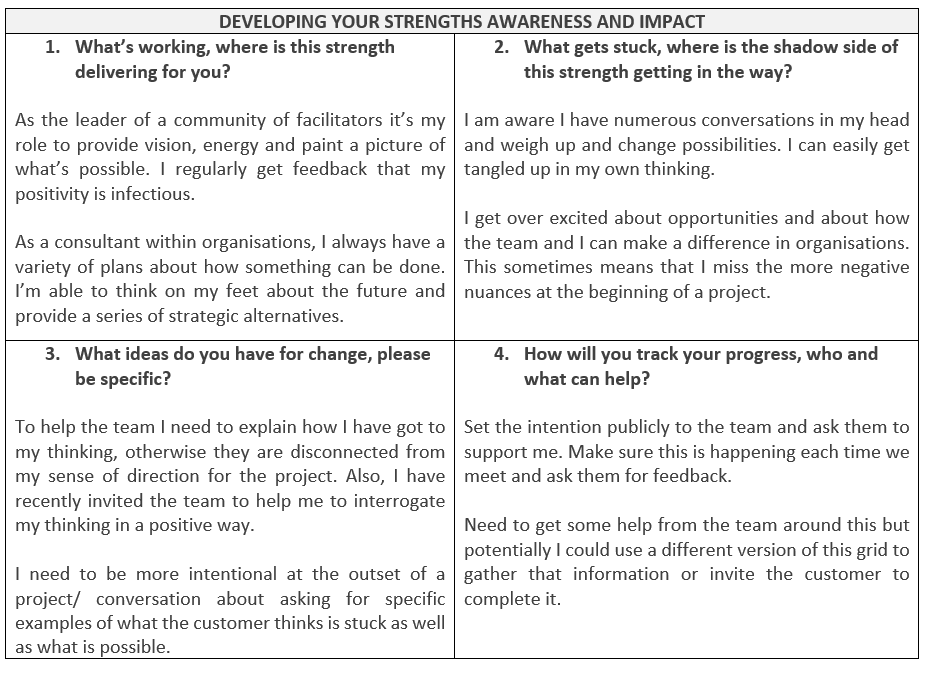
In the spirit of transparency, vulnerability, and trust building, I suggest that you complete the grid for one of your strengths and give that to your people before you ask them to complete this activity.
Thereafter have the conversation around what has emerged for people around the activity. I think around an hour to have a 1-1 on the 5 strengths.
TEAM DEVELOPMENT SESSION
To make the best use of the next set of tools you need to have completed the INTRODUCTION TO STRENGTHS session and asked them to complete the Strengths Development Map.
The Strengths Based Development Map is built around the Appreciative Inquiry model. It is a record of a conversation between a person talking about their strengths and the person facilitating the conversation, this may or may not be a line manager. The suggestion is that the team member comes to the conversation with their map completed in draft and the person facilitating the conversation has the role of helping them to take their thinking further.
The overall conversation is likely to be about 60minutes and should be held by reflective questions and listening. Everything about the rules of engagement apply here.
Your job as the facilitator is to dig into what they have prepared and shared, using powerful questions to support them to dig into their thinking and commitment.
Think about the time before you start. As a guide:
- 5-10 minutes to settle in; what have they been thinking about since you last met?
- 15 minutes of the experience of the WWG; how did they find the experience, what has changed about their understanding of their strengths as a result, so what will they do with that knowledge now? Suggest they share their thinking with their line manager at the next Touch Point meeting.
- 25 minutes on the development map; how did they find the experience, what has changed about their understanding of what they need to do with their strengths now, who can help them, how will they get feedback? Suggest they share their thinking with their line manager at the next Touch Point meeting.
- 5 minutes to thank them and close appropriately.
GUIDANCE FOR THE INDIVIDUAL
This Strengths Development Map gives you a different way to start thinking about your contribution to yourself, the team, and the work. The idea is that you print this on A3 paper, although it is also available in a table format if that is your preference. The Strengths Development Map is read alongside your reflections using the WWG for your top 5 strengths.
Arrive at the conversation with your completed WWG and a draft of your thoughts on the Strengths Development Map. After you have the conversation, we suggest you share the thinking the next time you are with your line manager at a 1-1.
They have guidance on how to have these conversations with you.